After our rainy experience in the Bernese Alps we drove back to the eastern part of Zwitserland where Nando is living. We had some nice sport climbing days in Berschis and Haldenstein. Also the rescue techniques training sessions very really nice.
sportclimbing in Berschis, Nando in "panic", 7a
The Kanton Graubünden (east part of Zwitserland) offers loads of opportunities for sportclimbing, multipitch climbing and alpine climbing. The rhine valley has a very mild climate and you can climb almost all year round (no, of course I am not jealous...).
A week later we have been to the Julier pass climbing "Römerweg". A 11 pitch well bolted route with 6a max.... Down in the valley it was 33 degrees or so and up on the pass it was 20 degrees with quite a lot of wind...
Piz de las Coluonnas at the Julier pass
Good topos you can find in the Swiss plaisier guiding books "east" and the "extreme east". If you plan to stay there longer the SAC climbing guide http://www.weltbild.ch/3/18069051-1/buch/kletterfuehrer-graubuenden.html is recommended.
In the week of 15th july I visited the Blümlisalp area in the Bernese Alps. Long long time ago I have been up there but never climbed a mountain of that range (bad weather). I know the area from the ice climbing stuff in winter, down in Kandersteg there are a few dozens of ice routes in all grades.
Reason for going to this area in summer was that my climbing partner Nando and 3 of his mates wanted to train for the summer course of the Swiss guiding school. All of them are preparing for this summer course, if they succeed they are aspirant guides, which is a major step in the guiding school. The Bluemlisalp range offers a great selection of easier rated climbs (AD and D) which are typically guiding areas. So a great opportunity for them for training and for me an excellent option to learn a lot about rope and rescue techniques.
The weather forecast was predicted good for the whole week, which is quite uncommon for this area. On monday we went up to the Fründenhut at around 2500m. A 1000m climb above the Oeschinensee, really nice views.
Next day we started at 5 in the morning for climbing the west ridge of the Fründenhorn. We walked up to the Fründenjoch, and from that col you turn left, first on easy ground (but very loose) up to the first tower. The first tower has to be climbed by a traverse on the south side, still not really diffcult but still really loose.
in the col, sunrise in the Wallis (looking south)
The second tower has to be climbed directly on the edge. there are a few bolts and some slings. It is a bit overhanging and rated 5b. Nice climbing.
overview of the west ridge above the col
looking south with Bietschhorn
on the westridge, just below the crux
Then the clim continues sometimes scrambling sometimes climbing and some snow fields have to be passed. We were on top at 10.30h. Great views to the east (Eiger, Mönch, Jungfrau, Aletschhorn) and to the south (Weissmies, Weisshorn, Matterhorn....).
After a good break we started our descent, great views down to the Oeschinensee. Two hours later we were back at the hut.
Descent, in the background the lake about 1300m lower...
Next morning we started at 5 again for climbing the Galletgrat of the Doldenhorn. It was cloudy (the weather forecast predicted a nice and sunny day). At 6 it started raining heavily and at 7.30 at around 3000m we decided to turn around. We had just passed a water drained slab with our crampons, so we had to find a different way down... good exercise though. At 9.30 we were back at the hut, completely wet and cold..... it turned out that the forecast for the whole week was too bad for climbing in the higher mountains. So we decided to walk down again....
After climbing the Marmolada south face we tried to climb
the third pillar of the Tofana di Rozes close to Cortina d’Ampezzo, but it was
raining and according to the guardian of the Dibona hut there was still too
much snow on the north side. The descent could be dangerous due to wet snow
avalanches… After our experiences earlier that week we wanted something
different: solid rock+ long routes+ no bolts+ good weather = Val di Mello.
After six hours driving we arrived in the Mello at 9.00 PM.
Next morning we set out for climbing Luna Nascente. This is one of the major
classics in the valley: 11 pitches up to 6b+ along with some really cool cracks
and diedres.
Candidates of Luna Nascente should be confident in climbing
cracks, placing friends and last but not least they should be really confident
on slabs. There are two pitches of slab climbing (pitch 9 and 11) that require
good technique and a “Zen”like mind.
Pitch 9 is a traverse of 40 meters on a
slab with exactly one piece of protection possible. Pitch 11 is even better: a
diagonal climb on a slab of about 45 meters with one piton after 35 meters.
Falling in this pitches results in a king swing for both the lead climber as
well the seconding climber… as always, don’t think about falling – you must
climb this route because of the Yosemite like features of cracks and diedres….
Really really cool…. All other pitches are perfectly protectable!!
pitch 11: looking back, a lot of rope, no pieces of protections....to be honest, I was happy that Andreas had to lead that pitch :-)
The 6b+ pitch halfway up is brilliant technical climbing.
The topos say to use a friend no.4 under the expanding flake at the start of
the pitch – if you do this like I did, you really get an interesting end of the
pitch because after climbing the 6b+ you climb up in a big crack for another 10
meters. I only had one friend no. 4 and that damn thing was down there at the
expanding flake which meant to me that I had to climb to the belay with my last
piece of protection 15 meters underneath….
start of the second pitch just before the underhand traverse to the right
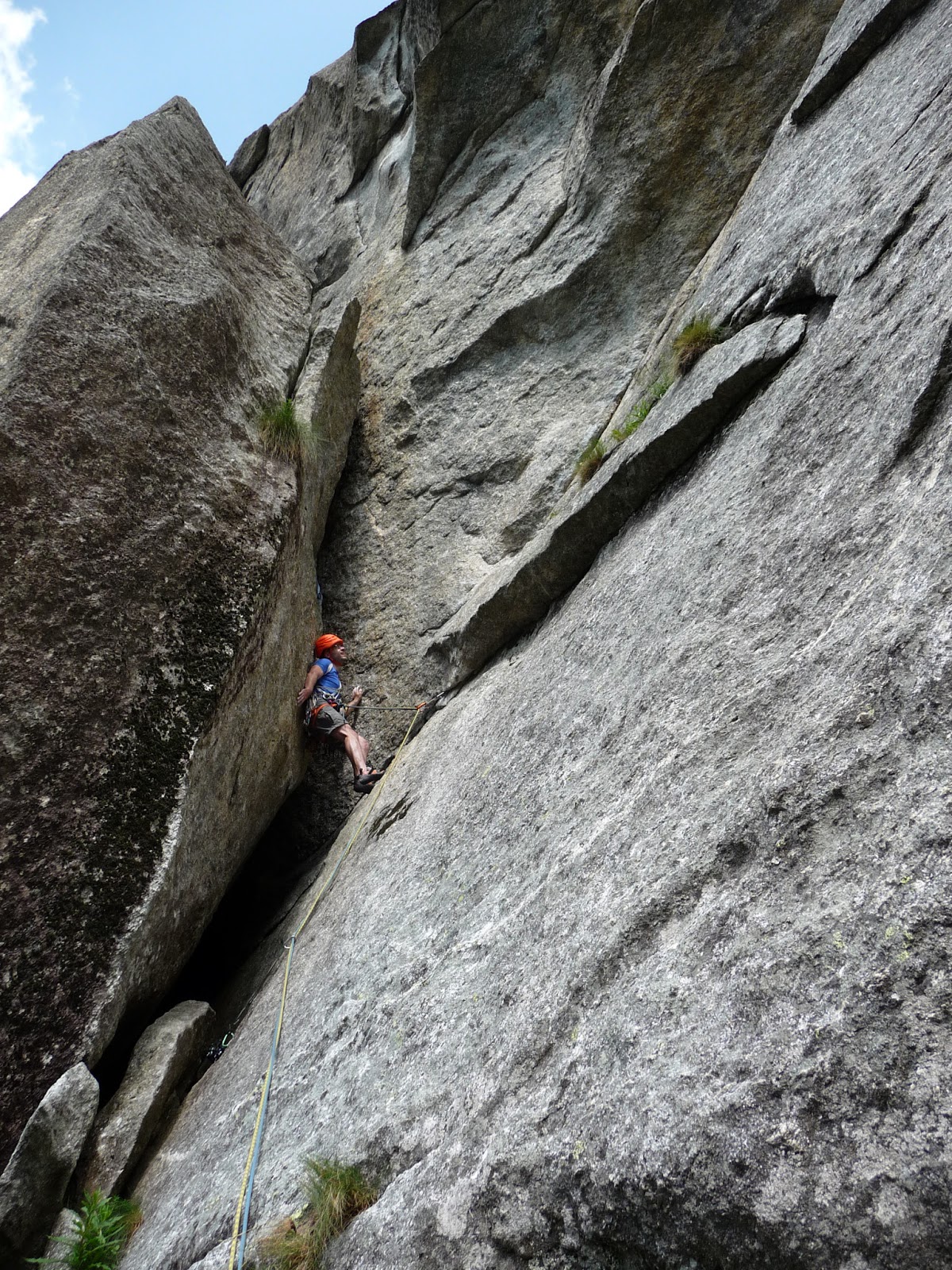
the third pitch: brilliant piaz crack
the fourth pitch: crack attack...
7th pitch: after the 6b+ pitch this is another 50m crack...
no bolts, only pitons, but in this solid rock we don't care...
oops, we did it again...
FACTS: Luna Nascente, we took a 60 m dubbel rope, and a dubbel
set of friends with one no.4 :-),
it can be really hot, so don’t forget tot take enough water with you. Good topo
is in the German Topoguides books.
From a climbers point of view spring was quite disappointing. My december/januari ice climbing season was good and I hoped to climb some bigger routes in march or april. But the weather was too bad for big stuff. So overall the last months were good training months and we did some good sportclimbing - but nothing special.
On 30th of june (last week) Andreas and I climbed the south face of
the Queen of the Dolomites – the Marmolada (3000m plus). We already
planned to climb the face last year but due to bad weather we finally
went to the Dauphine. But we promised to come back for a second attempt.
We had one week for climbing in the Dolomites – but as always – behind
your desk at home you make the wildest plans for climbing as much as
possible in one week. We both learned the last years that big routes
need focus and patience. Weather and conditions does not always allow to
climb when you like it. We arrived on Saturday in Canazei – and at our
arrival it was immediately clear that climbing the south face would be a
real adventure. There was still a lot of snow everywhere.
After 10 hours driving - red wine in Canazei
After a call
with the Falier hut we decided to walk up on Sunday. The guardian
thought that the lower part of the route could be wet but the upper part
should be o.k. The weather forecast predicted a window on Monday,
Tuesday would be worse. From behind our desks we had planned to do some
warm up climbs in the area – Andreas had climbed a lot in the Dolomites,
but for me it was the first visit. Since the weather forecast was only
good for one day we skipped the “starters” to immediately eat the “main
course”.
On our way to Malga Ciapela we saw the Marmolada glacier on the
north side of the mountain – loads of snow. We decided to take one pair
of crampons and one light ice axe with us for the descent. Next day we
already needed the crampons and axe to get to the base of the climb – wise
decision though.
ready to climb...
After a nice hike of about 2 hours we reached the Falier hut and we
had a marvellous view on the south face and particular on our route
“Don Quichote”. This route is about 900m, 25 pitches or so and up to
6a/6a+. Under normal conditions you can climb the face on this route in
about 6-10 hours.
first view on the face
Don Quichote
The guardian told us not to start too early, so we
left the hut at 6.00h. But even to get to the base of the route took 1,5
hours (instead of 1 hour) because the amount of snow. And again: from
behind our desks we thought to climb the first pitches on a running
belay but as we started the first pitch we recognized that the route was
still very wet – no running belay – even in the easy pitches we had to
climb carefully… whatever – we were on route and that was exactly what
we wanted to do - climbing on a massive face- being alone- under
difficult conditions. In june/july the days are long and it was great to
be on the mountain with another good climber, together we would make it
to the summit – no doubts.
start at 6.00 at the Falier hut
you never walk alone...
snow at the base
the first chimneys...
Andreas is leading
We made progress- chimneys- slabs- diedres, sometimes dry often wet
rock made the climbing adventurous. We were half way at 13.00, there
was a lot of snow on the ledge, we plowed up to the start of the second
part – the pillar.
snow at the ledge half way
the upper pillar...
Andreas leading...
a short steep roof with big holds - but even there it was a bit wet...
Actually the weather wasn’t that good as predicted-
clouds all day and for the final pitches even some snow and hail were
part of this alpine game. Because of the crampons, the ice axe, bivy
bag… the backpack was pretty big and heavy. So actually the lead
climbing part was a kind of a reward because the seconding climber had
to work hard as the donkeys down in the valley. We cursed the backpack
and called her “Ushi”. Ushi wanted to go down all day long but we would
go up. During a short snow-storm I reached the summit – 30cm of snow on
top – crawling up through the snow to find a big rock making the final
belay…. It was 20.30h. Andreas came up – we were happy.
alpine climbing how it goes
brilliant deep views on the very top of the pillar... a lot of snow en route
Andreas exiting on the top... is it winter of summer climbing? nobody knows....
After a short
search I found the rappel down to the glacier on the north side. With a
second rappel we were on the flat part of the glacier and we walked down
to the middle station of the Marmolada cable car. The station was
closed but we found a “cozy” spot in the snowplow-parking lot. It was
cold and our clothes were wet – but the spirits were still high. So we
installed our biwak on some wood and went into the bivy bag…. Shivering
all night, at 4.30 I got up for some walking and jumping to get it warm
again. It was a beautiful sunrise of what would later be the start of a
nice and warm summer day (weather forecasts are bullshit….). I was
astonished – Andreas slept quite a while. I could’nt understand how he
dit that, but anyway. The cable car station got open at 8.30 and the
dubble shot espressos were great!!!
cold and wet...
hotel snowplow :-)
next morning- great to feel the sun and minutes later the espresso...
and some real food....
FACTS Don Quichote: classic moderate rock climb, 25 pitches, 6a/6a+, Falier hut as start for the routes on the south face, we used 60m dubble rope, a good rack of friends (0,1 tot 3), slings are really useful. Conditions can only improve this summer. The problem is that you can't see the wet parts of the route from down the hut (chimney in the upper part of the first part and the last pitches just below the summit). They are faced to the west and do not get a lot of sun!
A must have is the Giordani climbing guide of the Marmolda south face.
Finally, temperatures are rising and we can spent more time outside climbing and hiking. Last sunday we went to Duisburg for the first time this year. Climbing in the Landschaftspark is special. The routes are not really high, maybe 10m, but you climb on old concrete buidlings. So basically you are climbing on a artifical wall. holds are very thin and the steeper routes are very crimpy. For us it is just a 40 minute drive to Duisburg. I climbed a few 7-/7 routes. When you get tired in your fingers it's nice to finish the climbing day on the sector Nordparkhütte. The guys from the German alpine club built some really nice routes with plastic holds into the roof of the building. So the first 8 meters are only vertical and thereafter you climb for 10 meters or so on a maximum overhanging roof. good power workout for your whole body.
After that the climbing day ends with an Erdinger and a really good currywurst!
Last tuesday we went to Berdorf, Luxembourg. Last autum we went there for the first time - in the weekend. The climbing is great but it is too busy. The owner of the camping told us that the ministery gave already 3000 climbing permits. I really do not understand this "policy". Normally you give permits to restrict access to a area. But if everybody get's a permit you're not in control anymore. Well, we arrived on tuesday and there was nobody!!! not on the campground or on the climbingsite. It was warm, maybe 20 degrees. So we had a great time on the rock. We also made a really nice hike through the woods down to Echternach and back. So if you have a few days in Berdorf, take a few hours off from climbing and check out the rest of the area.
We climbed some really nice routes again: my favourite route during this trip was "Heinz" in the sector "was not was". really cool combination of roof and wall climbing with a quite tricky finish close to the lower off. Other nice routes we climbed was Sirene, Bibi, Minimops and petit Trou (6a-6c).
I'm just back from 6 days of holiday in Portugal. Together with Marieke I went to Paul in Estoril. Kind of reunion with the well established traditions of drinking wine and whiskey, good food and nice stories. It was great to see Paul again, the last big trip together is already 5 years ago - summiting Mount McKinley. We are already making plans again but currently the Pauls focus is more on his family and home, but I'm waiting for the trips in the future.
It was pretty warm - 15-20 degrees, nice warm sun and sometimes rain. We visited two really cool climbing spots. The first one is located close to Estoril and is called Guia. Cool limestone routes, it is well bolted and you climb close to the sea. The area is pretty impressive and the nice thing is that easy routes in the lower grades are close to the harder routes.
The second area is Rocha da Pena in the south of Portugal, about 40 minutes drive from Faro. The limestone cliffs get sun early in the morning and are easy accessible by car, followed by a nice hike of maybe 15 minutes. The limestone is solid and sharp and the routes are well bolted as well.
These rock climbing days are the first rock days in 2013 and I must say: good start of the season. I climbed a few 6c's onsight, which is pretty good for my climbing level.
If you are looking for a nice spot of climbing in the south of Europe I really can recommend Portugal. A nice topo is this one: http://www.climb-europe.com/RockClimbingShop/Portugal-Onsight-Rock-Climbing-Guidebook.html
Ryanair offers good tickets.
But there is one thing we learned and I want to warn you: our complete climbing gear was stolen out of our rental car at the very first day at the cliffs in Guia. The packs were not visible from the outside and after some research on the www we suppose that we were not the only climbers who have been visited... The rock climbing season is just starting, but especially in the south of Europe there are a lot of people with no job, no money and no future. The economic crisis is for most us something we know from TV, travelling in the south we can learn a lot from people who lost everything... But please be careful with your gear!!!
Well, last week I went to Cogne again, and like the trips before our primary goal was an alpine route in Chamonix. I think Cogne is getting more than an alternative, the weather is always good, you always find ice here, and even after 20 climbing days here in Cogne there are still plenty of routes to climb.
On our arrival day Miel and I climbed the Stallatito de Cristallo, WI 4+. Good warm up.
At the start of the Stallatito de Cristallo... after 10 hours driving a nice physical activity
Next morning we moved a bit more to the right to climb Tutto Relativo, WI4. But there were people ahead, and with -17 degrees it was definitely to cold to wait an hour or so. So we traversed back to the left and climbed the Stallatito a second time, really nice. After that we got our chance to climb Tutto Relativo, the first two pitches are easy, but then things get really steep, it was cold, but the ice wasn't too bad. Afer the final pitch we walked up and around to go down again to the start of the route.
The crux pitch of Tutto Relativo...
We got some sun, had a hot tea and then crossed the valley to the other side to give Coyote another try. After the first pitch we aborted the climb because of a serious shower, within minutes everything was soaked, and immediatiley frozen. It was time to get down, and at 17.00 we had a nice Paulaner beer in Cogne.
Next day we went into Valleille again for climbing the cold
couloir. We were pretty early trying to be the first en route. But as we
arrived at the start more than 3 rope teams were preparing, so we decided to
come back another time and walked back to Stella Artice.
Stella Artice is a pretty impressive route, with a long 60m
start at WI4. But this is just the warm up for the very steep and long
free-standing pillar of the 2nd pitch. In januari the pillar wasn’t yet thick
enough for a save ascent, but now it was very massive – about 2x1 metres
thickness. I never lead climbed a steep massive pillar like that. So it was
prettyexciting. But it was really cool
climbing.
The left line is Stella Artice...
Steep ice is definitely fun!
the final pitch of stella artice...
Funny thing is if you climb steeper ice routes it feels more like
rock climbing – and that’s what we know and like! Miel second the steep pillar
– he was really fast. After the steep pitch we had an easy snow pitch and the
last pitch was hard to climb. Really hard ice, it was difficult to place the
ice screws and my calf muscles were burning as hell. Anyway, we climbed that
last pitch and in 4 abseils we were down again. It was a really cold day and
even in the sun it was -15 or so.
Stella Artice gets some sun after 12.00h, Miel is rappelling down the first pitch and you can see some guys from Chamonix climbing the pillar
The last day we climbed the first 3 pitches of cold couloir,
this time we the first party at the start. At 11.00h we were back in Lillaz for
a coffee.



P1090503.JPG)


